
Purpose vs. Pressure: When Workforce Analytics Revealed Hidden Structural Risks
Updated: Apr 22
Even in mission-driven institutions, pride and purpose do not automatically translate to sustainable engagement.
In 2025, Premier Value Provider, Inc. (PVP) partnered with a major Philippine financial institution to gain a deeper, data-driven understanding of its workforce experience using the HRMetre™ system.
What emerged was not a story of failure — but one of strategic clarity.
The Context
Using HRMetre™, PVP conducted a comprehensive workforce health assessment:
1,930 employees participated (62% response rate)
118-item survey covering engagement, job satisfaction, eNPS, retention risk, burnout, stress, anxiety, and depression
Predictive driver analysis
Segment-level diagnostics
Qualitative insight mapping
At the surface, employees expressed strong identification with the institution’s public mandate and legacy. Pride in mission was high.
However, deeper analytics revealed structural pressure points that required leadership attention.
Key Insights
1. Engagement & Retention Signals
While employees valued the institution’s mission, engagement indicators showed significant opportunity areas:
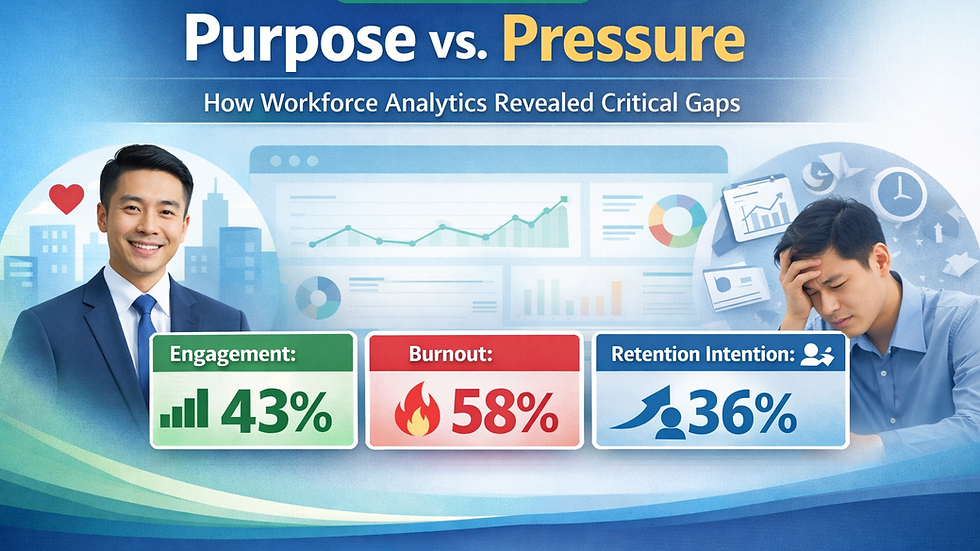
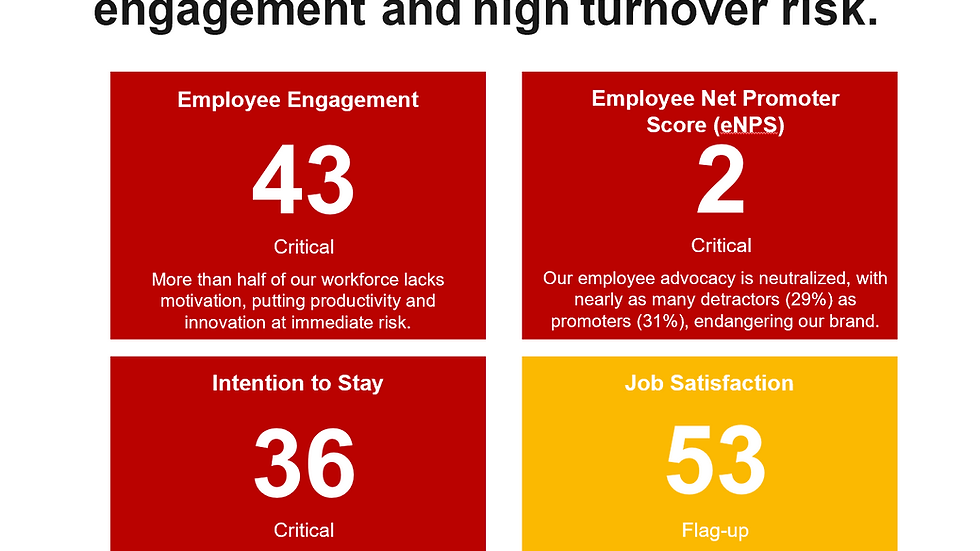
Engagement: 43%
Intention to stay: 36%
eNPS: 2
More than half of the workforce fell into at-risk or disengaged categories.
The data suggested that purpose alone was not sufficient to sustain motivation under operational strain.
2. Structural Workload Pressure
Mental health indicators signaled sustained strain across multiple dimensions:
Burnout: 58%
Anxiety: 58%
Depression: 51%
Stress: 29%
Predictive driver analysis consistently identified workload as the strongest structural pressure factor. This indicated that the issue was not perception-based — but systemic in nature.
3. Leadership Perception Divergence
Analytics revealed a meaningful divergence between executive and frontline perspectives:
Senior leaders rated leadership effectiveness positively.
Frontline employees reported lower levels of trust and execution confidence.
This alignment gap highlighted the importance of perception mapping in large institutions — where multiple realities can coexist.

4. Mid-Tenure Vulnerability
Segment-level diagnostics identified an unexpected risk cluster. Employees with 6–10 years of tenure — typically considered the organizational backbone — demonstrated:
The highest burnout and anxiety levels.
The sharpest drop in eNPS.
Leadership Response: From Insight to Strategy
The institution’s leadership demonstrated strong openness to evidence-based insight.
Rather than viewing the findings defensively, they treated the data as strategic intelligence. They used it to prioritize organizational risk areas and inform decision-making.
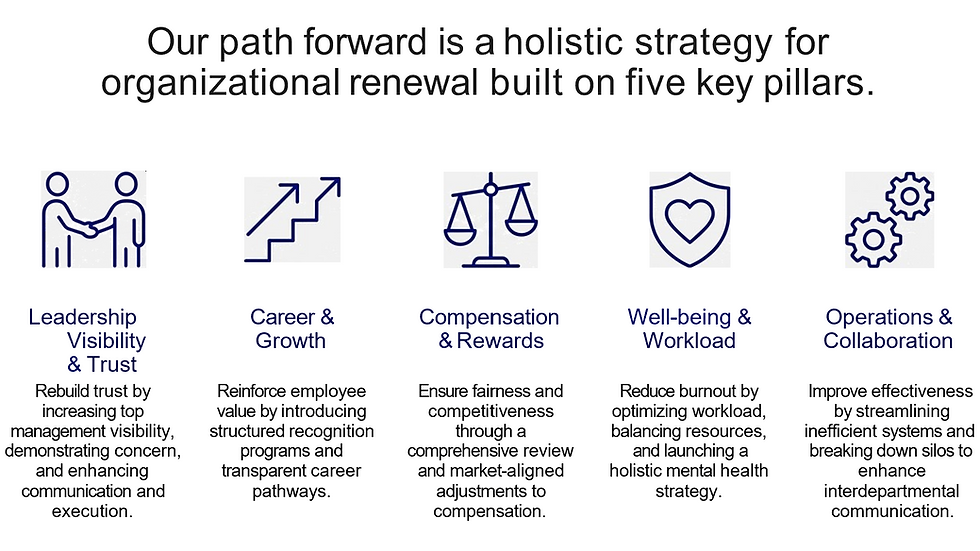
PVP worked with leadership to design a phased intervention roadmap.
The Strategic Roadmap
Short-Term (0–6 months):
Workload balancing interventions
Leadership visibility initiatives
Recognition “quick wins”
Psychological safety training
Medium-Term (6–12 months):
Career development framework
Compensation benchmarking
Workload monitoring systems
Pulse tracking
Long-Term (12–24+ months):
Leadership pipeline development
Embedded KPI alignment
Sustainable mental health infrastructure
Strategic Lessons
This case reinforces three critical realities:
Engagement is inseparable from workload, leadership alignment, and mental health.
Segment-level analysis is essential for identifying hidden risk clusters.
Analytics transforms employee surveys from feedback tools into strategic decision systems.
Purpose inspires people. But sustainable engagement requires structural support.

Takeaway
Workforce analytics does not exist to expose problems — it exists to make organizational reality measurable and actionable.
When institutions are willing to look beneath surface-level pride, they gain the clarity needed to strengthen resilience, protect retention, and sustain performance.
If your organization is experiencing burnout, retention volatility, or survey fatigue with limited action, it may not be a motivation issue — it may be an analytics gap.
With HRMetre™, PVP helps leadership teams uncover structural drivers, prioritize interventions, and convert insight into strategic action.
Because data, when used responsibly, becomes a leadership advantage.
Discover what your workforce is truly experiencing. WithHRMetre™, PVP can help your organization uncover hidden engagement risks, pinpoint mental health and workload challenges, and turn data into actionable strategies. Don’t wait for burnout or turnover to tell the story—see the insights for yourself and build a healthier, more resilient workplace.*


Comments